
Construction Robotics News
Construction Robotics News
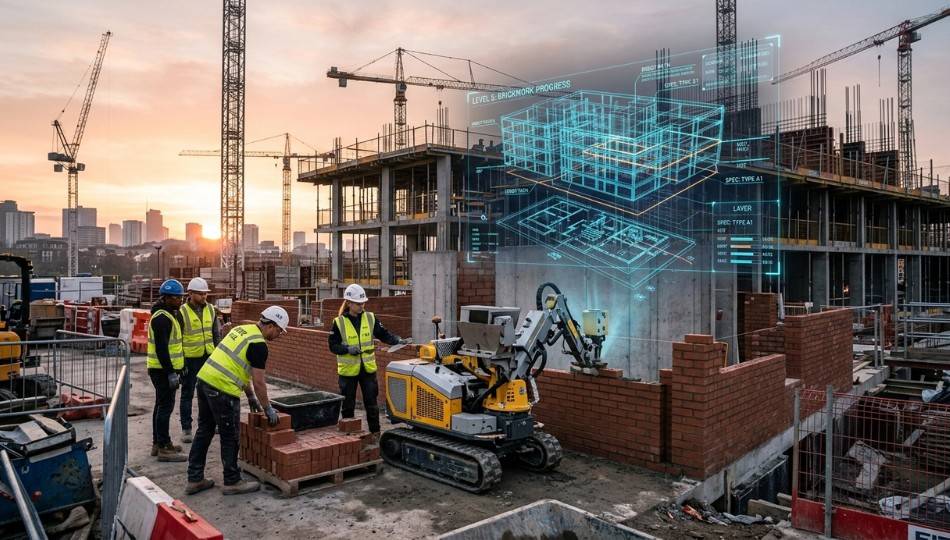
Back in 2019, I stood on a commercial build site watching six workers tie rebar by hand under a brutal Chennai sun. It was slow. It was exhausting. And honestly, it felt outdated.
Fast forward to 2025, and that same task can be done by a semi autonomous robot in half the time with near zero error.
Construction robotics news is no longer niche tech chatter. It is front line industry transformation. As someone who has tracked emerging technology adoption for over a decade, I can tell you this shift is bigger than most contractors realize.
And here is the kicker. The companies quietly piloting robotics today are positioning themselves to dominate the next construction cycle.
Let us break down what is actually happening.
What Is Construction Robotics?
Construction robotics refers to the use of autonomous or semi autonomous machines that perform tasks such as bricklaying, rebar tying, concrete printing, site inspection, and material transport. These robots combine artificial intelligence, machine vision, and automation systems to improve speed, precision, and safety on job sites.
According to the International Federation of Robotics, global demand for professional service robots, including construction systems, increased significantly in 2024 as labor shortages intensified worldwide. The construction robotics market is projected to exceed $168 billion by 2032, based on multiple industry forecasts.
That is not incremental change. That is structural disruption.
Why Construction Robotics News Matters Right Now
Here is the short answer. Labor shortages, rising material costs, and safety pressures are colliding.
According to the U.S. Bureau of Labor Statistics, the U.S. construction industry faces hundreds of thousands of unfilled positions annually. At the same time, workplace injury rates in construction remain among the highest across major industries.
And that is just the United States.
The World Economic Forum has repeatedly highlighted that construction productivity has grown at less than 1 percent annually over the past two decades, compared to nearly 3 percent in manufacturing.
Think about that gap.
Manufacturing automated. Construction largely did not.
Construction robotics news is surfacing because contractors are finally under pressure to modernize. Robotics is no longer experimental. It is becoming economically necessary.
In my experience, most contractors first look at robotics for cost savings. But what keeps them investing is predictability. Robots do not call in sick. They do not make fatigue related mistakes at 4 PM on a Friday. That consistency changes project scheduling entirely.
The 4 Core Categories of Construction Robots
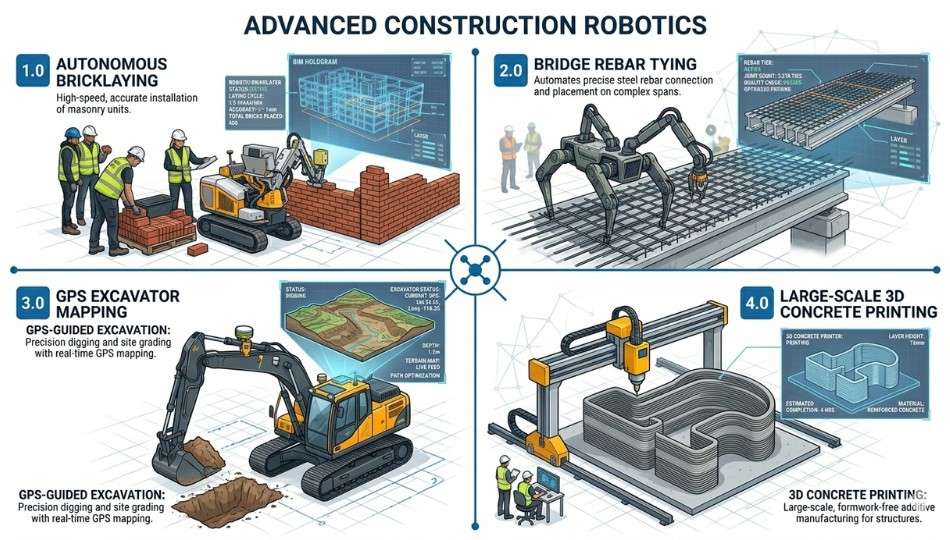
If you want to understand where the industry is headed, focus on these four categories. Everything else is noise.
1. Bricklaying and Masonry Robots
Companies like Construction Robotics developed SAM, a bricklaying robot capable of laying thousands of bricks per day with millimeter level accuracy.
That does not eliminate masons. It augments them. One mason with a robot can often double output.
Plot twist. Skilled masons who learn to operate these systems are earning more, not less.
2. Rebar Tying and Structural Automation
Advanced Construction Robotics introduced TyBOT, an autonomous rebar tying robot used on major infrastructure projects. According to company case studies, it can tie rebar intersections significantly faster than manual crews while reducing repetitive strain injuries.
This matters because musculoskeletal injuries are one of the most common construction claims.
3. Autonomous Equipment and Material Transport
Heavy equipment manufacturers such as Caterpillar Inc. are integrating autonomous haul systems and AI driven site analytics into excavators and loaders. These systems use LiDAR, GPS mapping, and onboard computing to operate with limited human oversight.
Autonomous haul trucks are already common in mining. Construction is catching up.
4. 3D Printing and Additive Construction
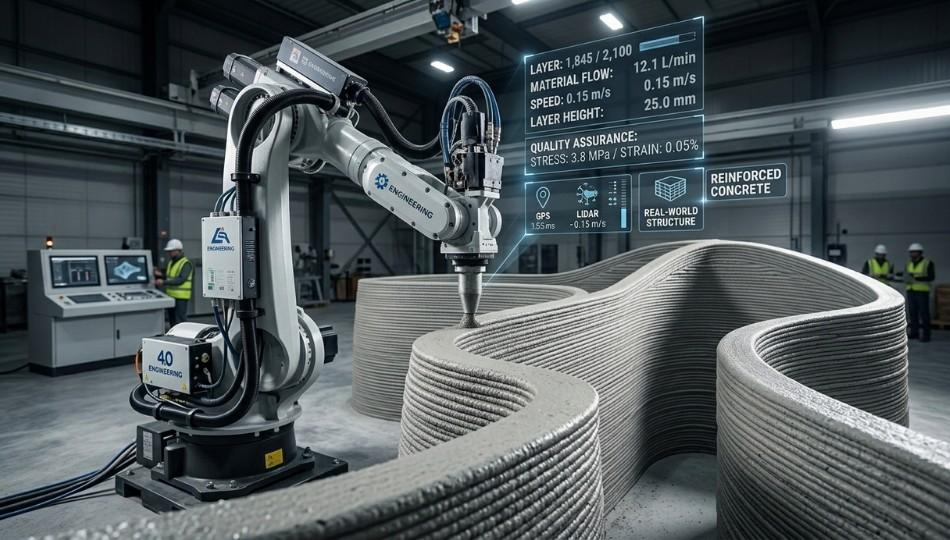
Robotic 3D printing systems can fabricate walls using concrete extrusion technology. Research from Massachusetts Institute of Technology demonstrates that large scale additive manufacturing can reduce material waste by optimizing structural geometry.
Less waste. Faster builds. Lower carbon footprint.
That combination is why sustainability focused developers are watching construction robotics news closely.
MIT research on large scale additive manufacturing demonstrates how optimized structural geometry reduces material waste.
How Contractors Are Actually Implementing Robotics
Now you might be wondering, how does this move from headline to jobsite?
Here is the practical rollout framework I have seen work.
Step 1: Pilot One High Pain Task
Most successful firms start small. They identify one repetitive, labor intensive process such as rebar tying or layout scanning.
They run a 60 to 90 day pilot. They track productivity per labor hour and error rates.
Concrete data builds internal trust.
Step 2: Upskill, Do Not Replace
Forward thinking companies retrain existing workers as robot operators and maintenance technicians. According to the McKinsey & Company, automation in construction will change job roles more often than it eliminates them outright.
I have seen this firsthand. A foreman I interviewed in 2024 initially resisted robotics. Six months later, he was leading the robotics integration team. His comment stuck with me. The robot handles the grind work. I handle the thinking.
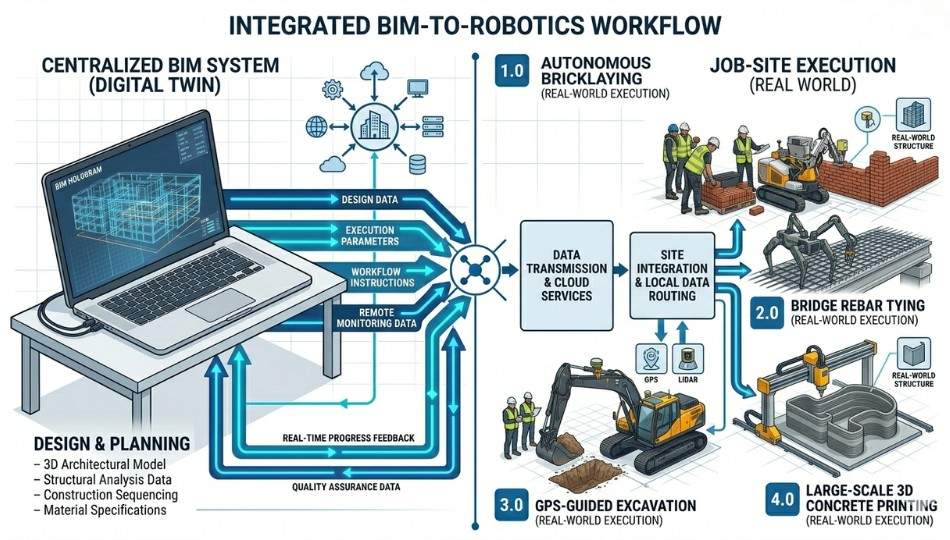
Step 3: Integrate with BIM and Site Analytics
Robotics works best when integrated with Building Information Modeling systems. Data flows from digital twin to physical robot. That alignment reduces layout errors dramatically.
This is where AI driven construction technology becomes powerful. Robots that connect to BIM models can self adjust based on updated plans.
Step 4: Scale Based on ROI
If the pilot shows at least 15 to 20 percent productivity improvement, most firms expand. If not, they recalibrate.
There is no magic bullet. But there is measurable upside.
Are Robots Replacing Construction Workers?
Short answer. Not in the way people fear.
Research from Oxford Martin School indicates that automation tends to transform job tasks rather than eliminate entire occupations. In construction, robotics often removes high risk repetitive labor while increasing demand for technical oversight.
Here is my slightly contrarian take.
The biggest threat is not robots replacing workers. It is companies ignoring robotics and losing bids because competitors deliver faster with tighter margins.
In competitive markets like Texas and California, large contractors are already factoring robotics capability into proposals. Clients care about timelines and safety metrics.
Construction robotics news reflects that strategic shift.
Benefits That Go Beyond Speed
Speed gets headlines. But the deeper benefits are operational.
1. Safety Improvements
Robots reduce exposure to high risk tasks such as elevated bricklaying and repetitive strain work.
2. Data Driven Decision Making
Many robotic systems collect site performance data in real time. That feeds into predictive scheduling.
3. Material Optimization
Additive construction methods reduce waste, aligning with sustainability mandates and ESG reporting standards.
4. Talent Attraction
Younger workers are more likely to join tech enabled firms. Robotics changes perception from manual labor to high tech craftsmanship.
But let us be transparent. Robotics is capital intensive. Smaller contractors may struggle with upfront costs. Leasing models are emerging, but adoption will not be uniform.
There is nuance here.
Final Thoughts: Where This Is Headed
After tracking construction robotics news for years, three things stand out.
First. Labor pressure is not going away. Automation fills a structural gap.
Second. The winners are not replacing people. They are augmenting them.
Third. Firms that start experimenting now will build institutional knowledge competitors cannot easily copy.
Whether you are a project manager, contractor, or investor, construction robotics news is not optional reading anymore. It is strategic intelligence.
If you have not explored a robotics pilot yet, start small. Measure honestly. Adjust quickly.
The future jobsite will not be fully autonomous. But it will absolutely be automated.
And the shift has already begun.
Frequently Asked Questions About Construction Robotics News
No. While early adopters were major contractors, smaller firms are beginning to access robotics through leasing partnerships and shared service models. Pilot programs can start with a single task rather than full site automation.
Most case studies report 15 to 30 percent productivity improvement in targeted tasks. Gains depend on training, integration quality, and task selection.
Yes, when engineered properly. Research from MIT shows that layered concrete extrusion can meet structural integrity requirements when reinforced and tested under building code standards.
Operators need basic digital literacy, equipment calibration knowledge, and BIM familiarity. Traditional trade expertise remains critical.
No. As of 2025, robotics adoption is expanding due to measurable ROI and documented labor shortages. However, not every solution will succeed. Some early products will fail. That is normal in technological transitions.