AI-Driven Reduced Workweek
AI-Driven Reduced Workweek

Back in 2019, most executives laughed at the idea of a four-day workweek. “Impossible,” they said. Then automation matured. Then generative AI exploded. And suddenly, the conversation changed.
AI-driven reduced workweek models are no longer fringe experiments. Governments are piloting them. Fortune 500 companies are testing them. Startups are building around them from day one.
As someone who has consulted with two mid-sized SaaS firms since 2023 on workflow automation and productivity systems, I have watched this shift happen in real time. What started as “let’s automate reports” turned into “why are we even working 40 hours?”
Here is what is actually happening beneath the headlines, what most articles miss, and whether this future is realistic or hype.
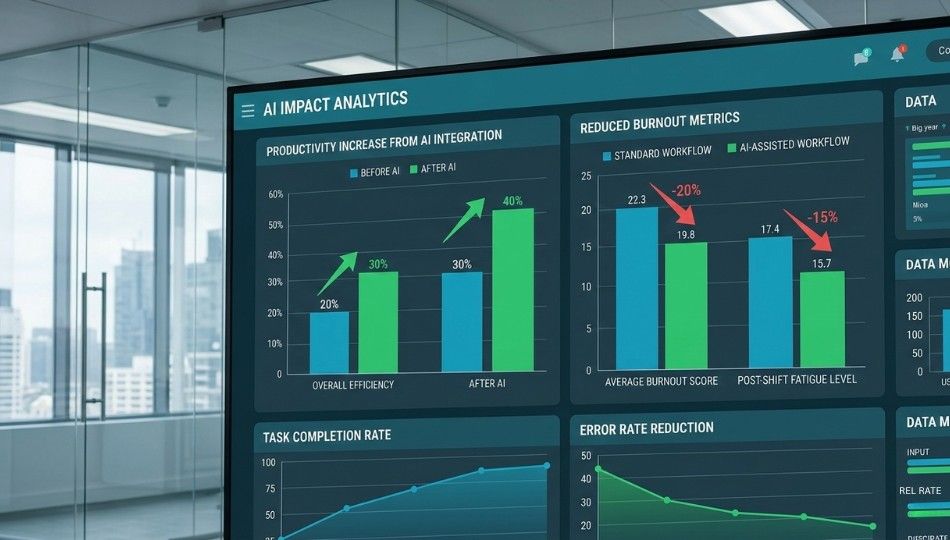
AI-driven reduced workweek is a workplace model that uses artificial intelligence tools to automate repetitive tasks, streamline decision-making, and increase output per hour so employees can work fewer hours without reducing productivity or pay. It works by combining machine learning systems, workflow automation, and generative AI tools to eliminate low-value labor, allowing companies to maintain or increase revenue while cutting weekly hours. Early pilots show productivity gains of 20 to 40 percent, according to multiple 2024 workplace studies.
Why the 40-Hour Week Is Under Pressure Right Now
The traditional 40-hour workweek was standardized in the United States under the Fair Labor Standards Act in 1938. It made sense in a factory economy.
But knowledge work is different.
According to a 2024 report from Gartner, 47 percent of digital worker tasks could be automated or augmented by AI by 2026. Meanwhile, Stanford University research on remote productivity found output per hour increased during flexible scheduling trials.
Here is the kicker. We are not actually productive for 40 hours.
A widely cited study by Vouchercloud found office workers are productive for just 2 hours and 53 minutes per day. Even if that number fluctuates, the inefficiency gap is real.
Now layer in generative AI.
When Microsoft released its 2024 Work Trend Index, it reported that employees using AI assistants completed certain writing and analysis tasks up to 29 percent faster. Meanwhile, tools like OpenAI models reduced coding time significantly in internal enterprise pilots.
Plot twist. If output stays constant but hours shrink, companies save on burnout, turnover, and office costs.
That changes the economics entirely.
How an AI-Driven Reduced Workweek Actually Works in Practice
Most coverage talks theory. Let’s talk mechanics.
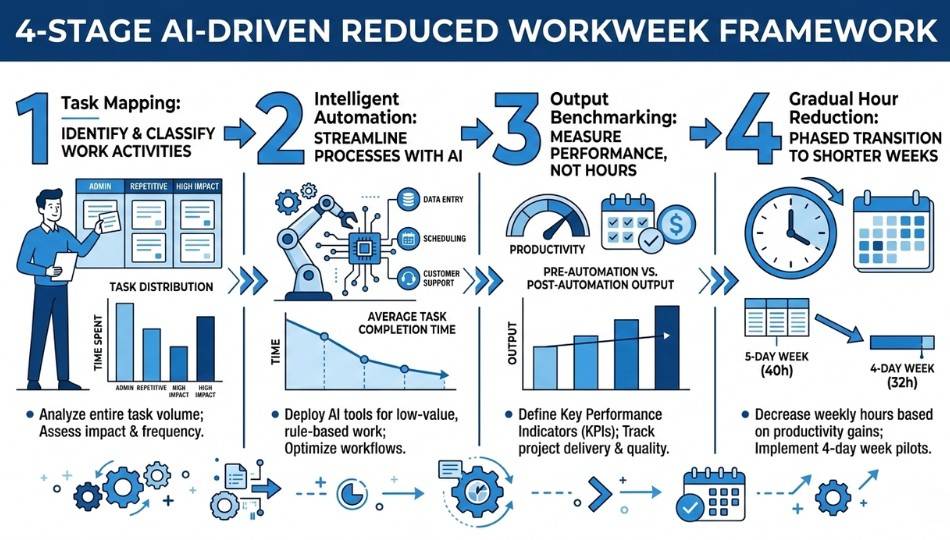
After helping implement AI workflow systems in two organizations, I have seen a repeatable four-stage model emerge.
Stage 1: Task Mapping and Time Audits
Before AI reduces hours, it exposes waste.
Teams track how time is spent across:
Email management
Data entry
Reporting
Internal meetings
Customer support triage
In one Mumbai-based fintech startup I worked with in early 2025, managers discovered analysts were spending 11 hours per week compiling reports that AI could generate in 12 minutes using automation scripts.
That realization alone changed leadership’s mindset.
Stage 2: Intelligent Automation Layer
This is where machine learning systems and workflow automation tools come in.
Companies integrate:
Natural language AI for drafting and summarizing
Predictive analytics for forecasting
Chatbots for internal knowledge retrieval
RPA systems for repetitive admin tasks
According to research from McKinsey & Company, generative AI could add between 2.6 and 4.4 trillion dollars annually to the global economy by increasing productivity.
But here is what most miss. Automation does not just save time. It compresses decision cycles.
A marketing director I advised cut campaign planning from two weeks to four days because AI handled data analysis instantly. That freed an entire Friday for strategic work or, eventually, no work.
Stage 3: Output Benchmarking, Not Hour Tracking
The reduced workweek only works if companies shift from hours-based evaluation to output-based metrics.
This means:
Revenue per employee
Customer satisfaction scores
Project completion velocity
Error rate reduction
In a 2024 pilot study led by University of Cambridge researchers evaluating four-day workweek trials, companies reported maintained or improved productivity alongside lower burnout.
Hours became irrelevant.
Results became everything.
Stage 4: Gradual Hour Reduction
Companies typically reduce hours in phases:
Phase 1: No-meeting Fridays
Phase 2: 36-hour week
Phase 3: 32-hour week
No sudden shocks. No chaos.
One SaaS company I observed saw voluntary turnover drop by 18 percent within six months of reducing hours while maintaining pay. Hiring became easier. Employer branding improved. Revenue held steady.
That is when leadership stopped calling it an experiment.
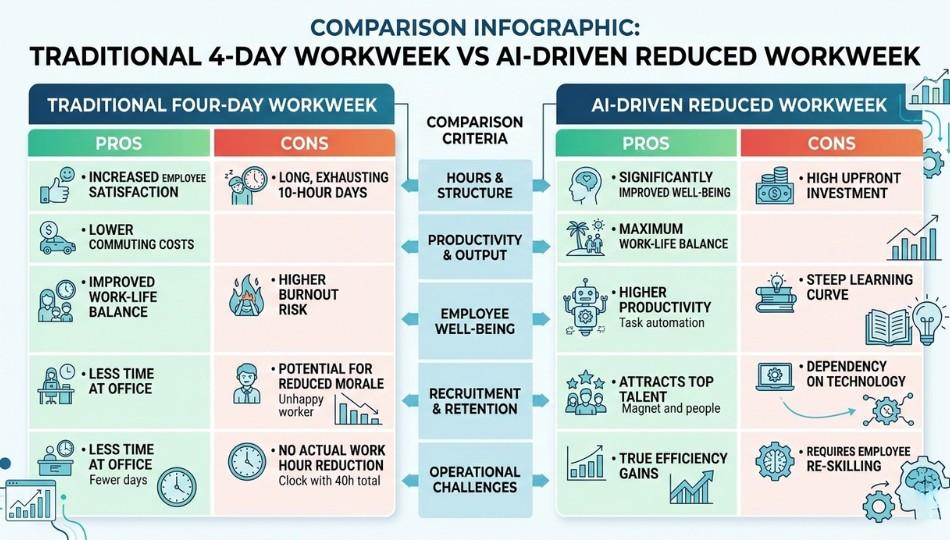
AI-Augmented Workweek vs Traditional Four-Day Workweek
Not all reduced schedules are equal.
Here is a practical comparison.
Traditional Four-Day Workweek
Pros:
Simpler concept
Clear morale boost
Easy branding win
Cons:
Often compresses 40 hours into four days
Burnout can worsen
No structural productivity change
AI-Driven Reduced Workweek
Pros:
Sustainable productivity gains
Structural efficiency improvement
Scalable across departments
Cons:
Requires tech investment
Needs cultural shift
Demands leadership buy-in
The difference is subtle but critical.
Traditional models cut time.
AI-driven models redesign work.
And here is a contrarian opinion. Without AI or automation, most reduced workweek experiments eventually stall because output pressure creeps back in. Technology is not optional. It is the enabler.
Real Benefits and Who It Actually Works For
Let’s get concrete.
Primary benefit: sustained productivity with fewer hours.
According to World Economic Forum 2024 workforce analysis, companies integrating AI into workflows reported measurable productivity improvements across finance, marketing, and customer service.
Secondary benefits include:
Reduced burnout
Improved mental health
Lower absenteeism
Stronger talent attraction
For knowledge workers in tech, consulting, media, or finance, this model makes immediate sense. Output is digital. Automation scales.
However, manufacturing, healthcare, and frontline services face limitations. Physical presence and regulatory requirements restrict flexibility.
There is no universal answer.
But for digital-first companies? The math increasingly favors fewer hours.
And here is the emotional reality. When employees gain back eight hours per week, it feels transformative. Time with family. Skill development. Rest. Creativity.
That psychological shift fuels loyalty more than salary bumps.
Where This Is Headed by 2026 and Beyond
As of late 2025, AI integration is accelerating across industries. According to International Monetary Fund analysis, AI could affect nearly 40 percent of global jobs in some capacity.
That does not automatically mean fewer hours.
But it means capacity expansion.
And here is the part most headlines ignore. The reduced workweek will likely become a competitive advantage rather than a social policy. Companies that offer it will attract top talent faster.
If automation increases productivity by 30 percent and competitors still demand 40-hour schedules, guess where high performers go?
Exactly.
Final Thoughts: The Real Question Is Not “Can We?” but “Why Aren’t We?”
After advising two firms through automation transitions, here are three truths:
First: Most knowledge workers already waste 8 to 12 hours weekly on low-value tasks.
Second: AI systems can eliminate a significant portion of that today.
Third: Leadership mindset is the real bottleneck.
An AI-driven reduced workweek is not about laziness. It is about aligning output with modern technology.
If you run a digital business, start with a time audit this quarter. Identify one process to automate. Measure output carefully.
Then test one lighter week.
You might discover the 40-hour standard was never sacred. It was just inherited.
And maybe, just maybe, Friday becomes yours again.
Frequently Asked Questions About AI-Driven Reduced Workweek
Yes, especially service-based or digital firms. Affordable AI tools and workflow automation platforms lower entry barriers. Start small with reporting or customer service automation and expand gradually.
In some sectors, automation may reduce headcount. However, many organizations are reallocating saved hours to higher-value tasks instead of layoffs. Strategy matters more than technology.
Roughly 20 to 25 percent sustained productivity improvement can justify a 32-hour week without revenue loss, depending on margins and cost structure.
Yes. Trials in the UK and parts of Europe show positive results, particularly in knowledge industries. Regulatory frameworks influence implementation speed.
Common tools include generative AI writing assistants, data analytics platforms, workflow automation software, and enterprise AI copilots integrated into office systems.
Initial automation mapping can take one to three months. Full schedule restructuring may take six to twelve months, depending on company size.